Applied AI · Master's research
AETHER
An AI pipeline that estimates hydrogen adsorption energy and supports catalyst screening for green hydrogen production.
- Role
- Research and pipeline author
- Period
- 2025 - 2026
- Type
- Master's dissertation
- Status
- Open source
- 5,860
- curated structures
- 0.9734
- best ensemble R²
- 5 seeds
- reproducible evaluation
The problem
Finding catalysts for the hydrogen evolution reaction through DFT calculations is expensive and slow. The practical question is whether a model pre-trained on millions of structures can replace that calculation within an acceptable error, and whether the advantage holds when the experiment is repeated across different seeds.
My contribution
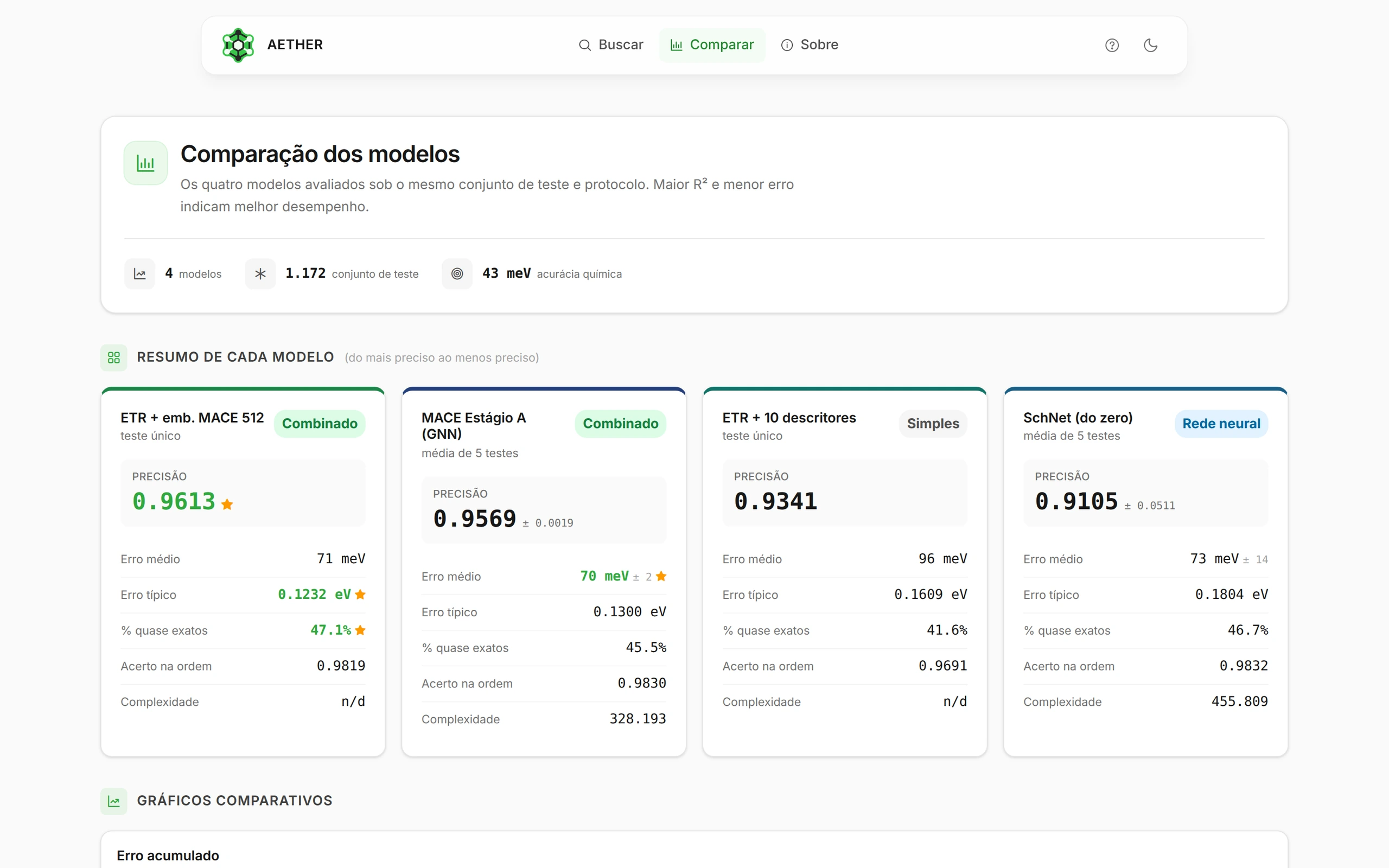
I built a reproducible pipeline for curation, training, comparison and explainability over 5,860 structures from Catalysis Hub, on a fixed canonical split. I compared four approaches on the same data (handcrafted descriptors, a GNN trained from scratch, a fine-tuned pre-trained equivariant GNN and regression over frozen embeddings), reporting mean and standard deviation across 5 seeds. Results are served through a FastAPI API with a Vue interface.
Technologies
- Python
- PyTorch
- PyTorch Geometric
- MACE
- SchNet
- SHAP
- FastAPI
Inside the product
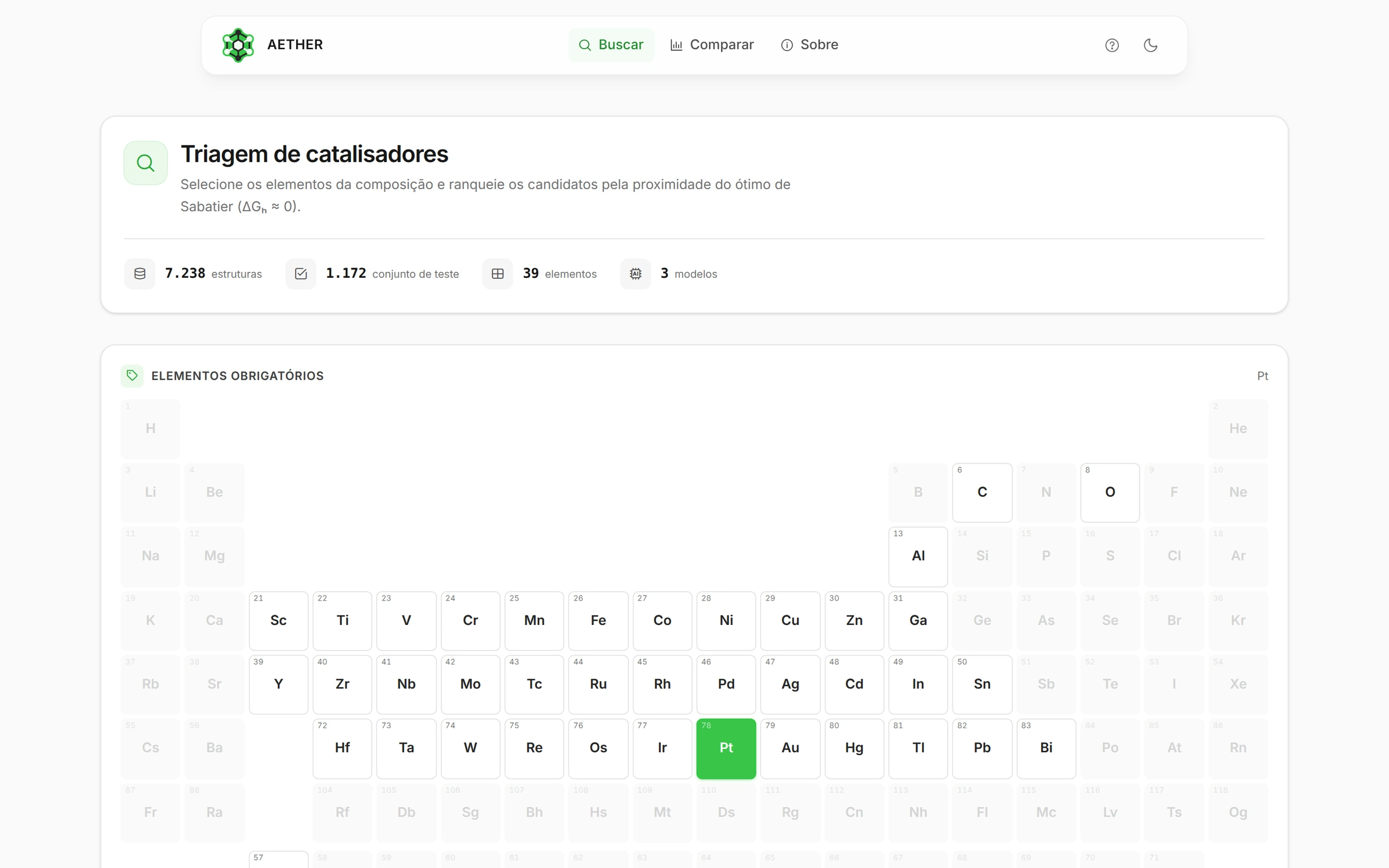
Screening starts on a periodic table that only enables elements present in the dataset, then ranks candidates by how close they sit to the Sabatier optimum. 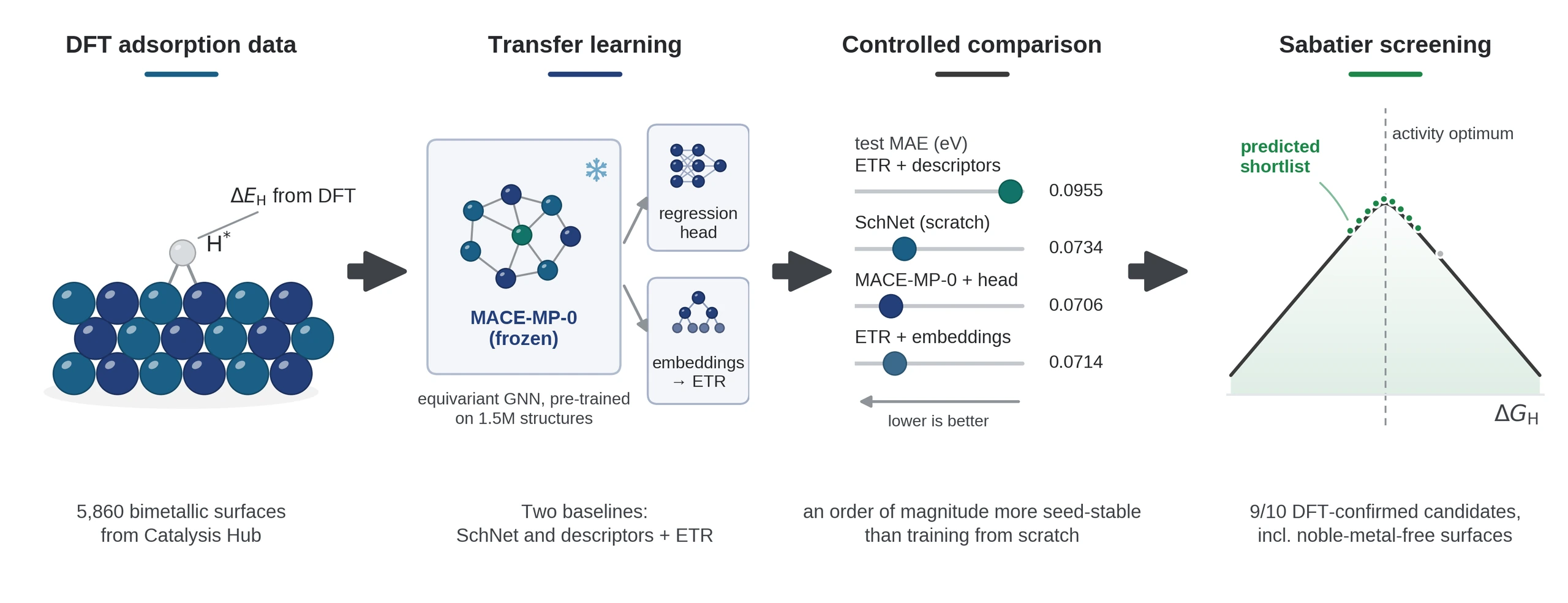
The study design, from DFT-computed adsorption through transfer learning to the final candidate screening. 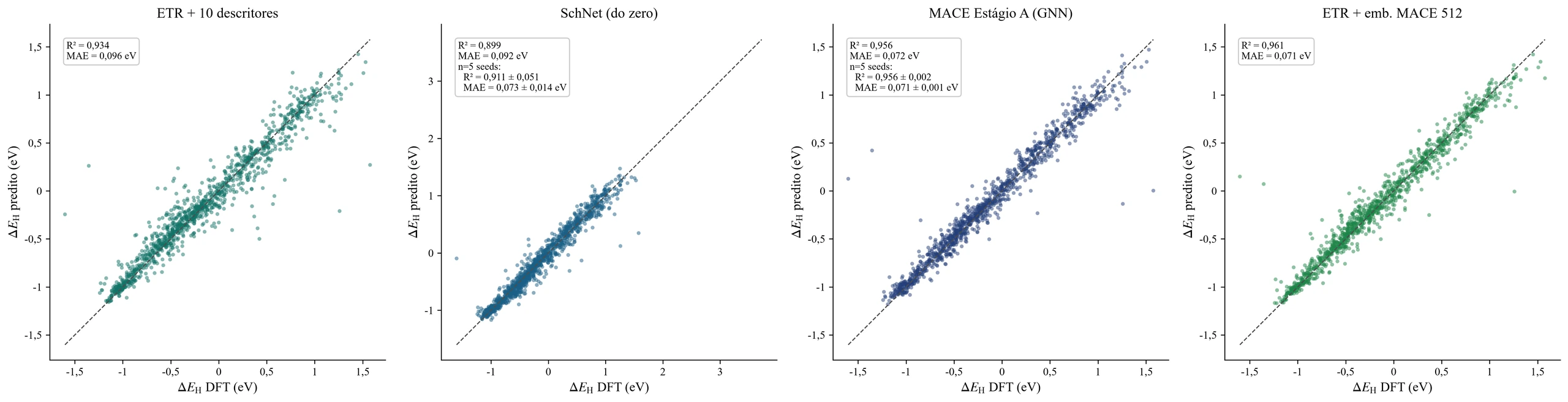
Predicted vs. DFT parity for all four approaches on the same test set. It is the comparison the conclusion rests on.